01. Theoretical basis
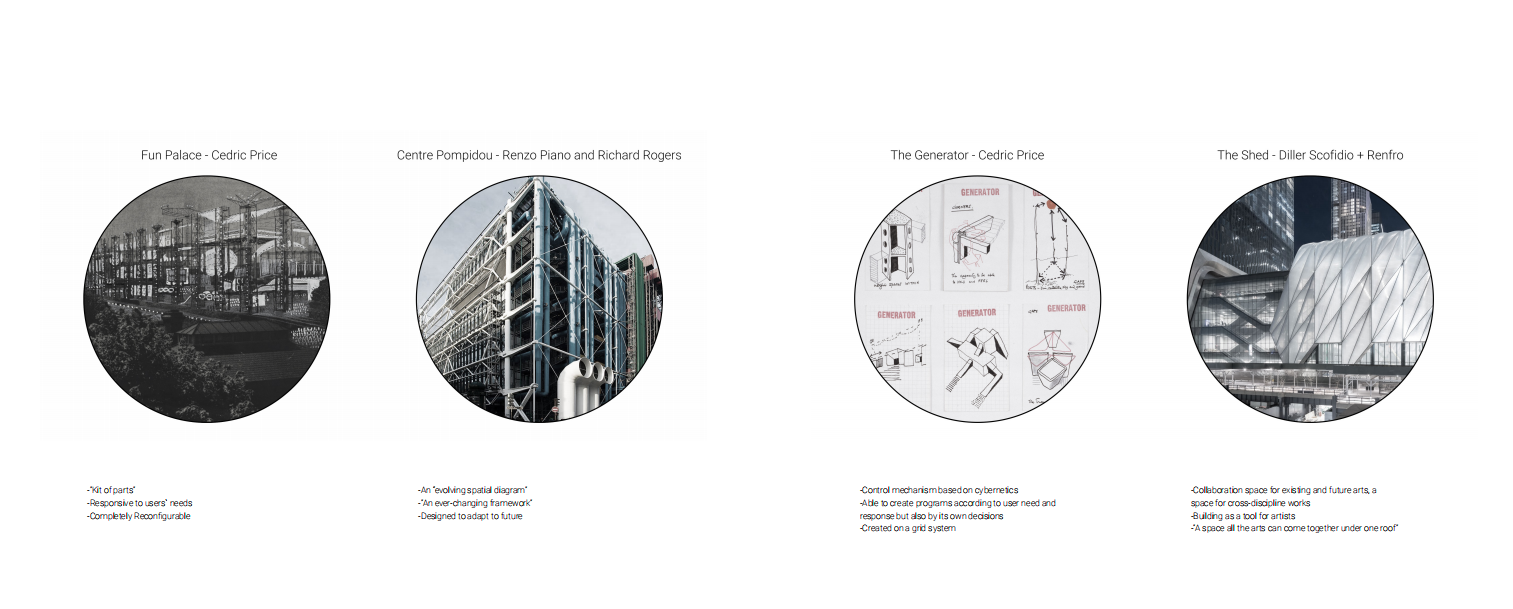
The project starts from a lineage of adaptable architecture: Cedric Price's Fun Palace proposes a kit-of-parts building that can respond to changing user needs; Piano and Rogers' Centre Pompidou treats architecture as an evolving spatial diagram rather than a closed monument; Price's Generator introduces cybernetic control into a grid system capable of producing programs from user needs and machine decisions; and The Shed frames the building as a tool that can support future cross-disciplinary art production.
Together, these references shift architecture from a fixed object toward an adjustable system. For the modular construction robot, the theoretical basis is not only formal flexibility, but the possibility of using mechanical control, modular components and user-responsive rules to keep space open to continuous reconfiguration.
02. Research purpose
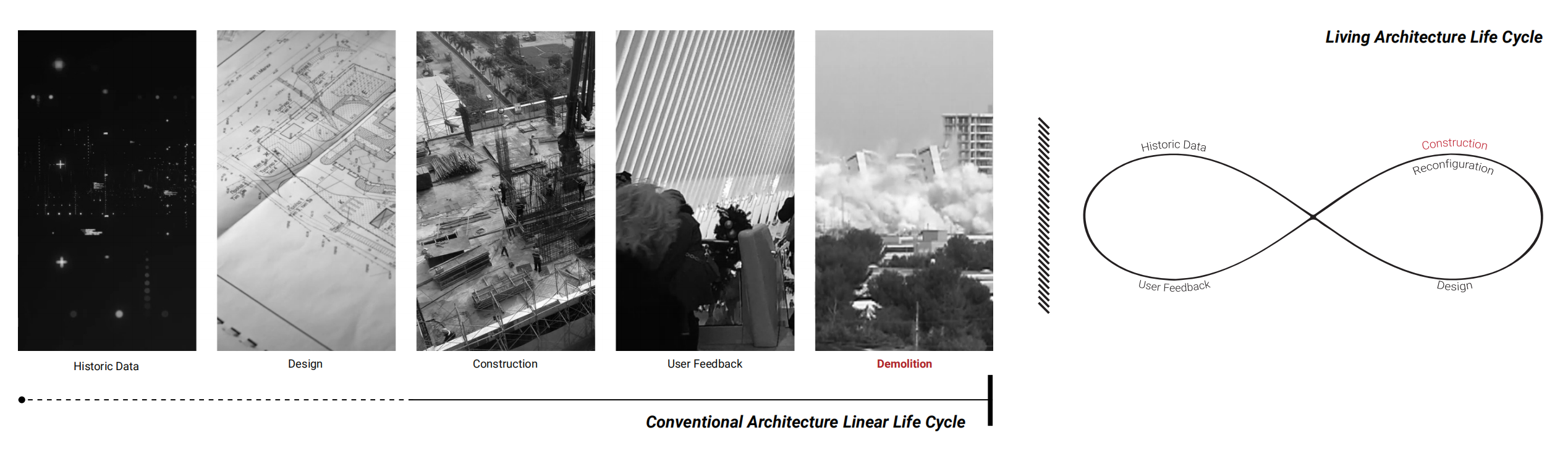
Conventional buildings are conceived as fixed outcomes. When programmes, patterns of use or spatial expectations change, adaptation typically depends on refurbishment, demolition and reconstruction—processes that consume time, capital and material resources.
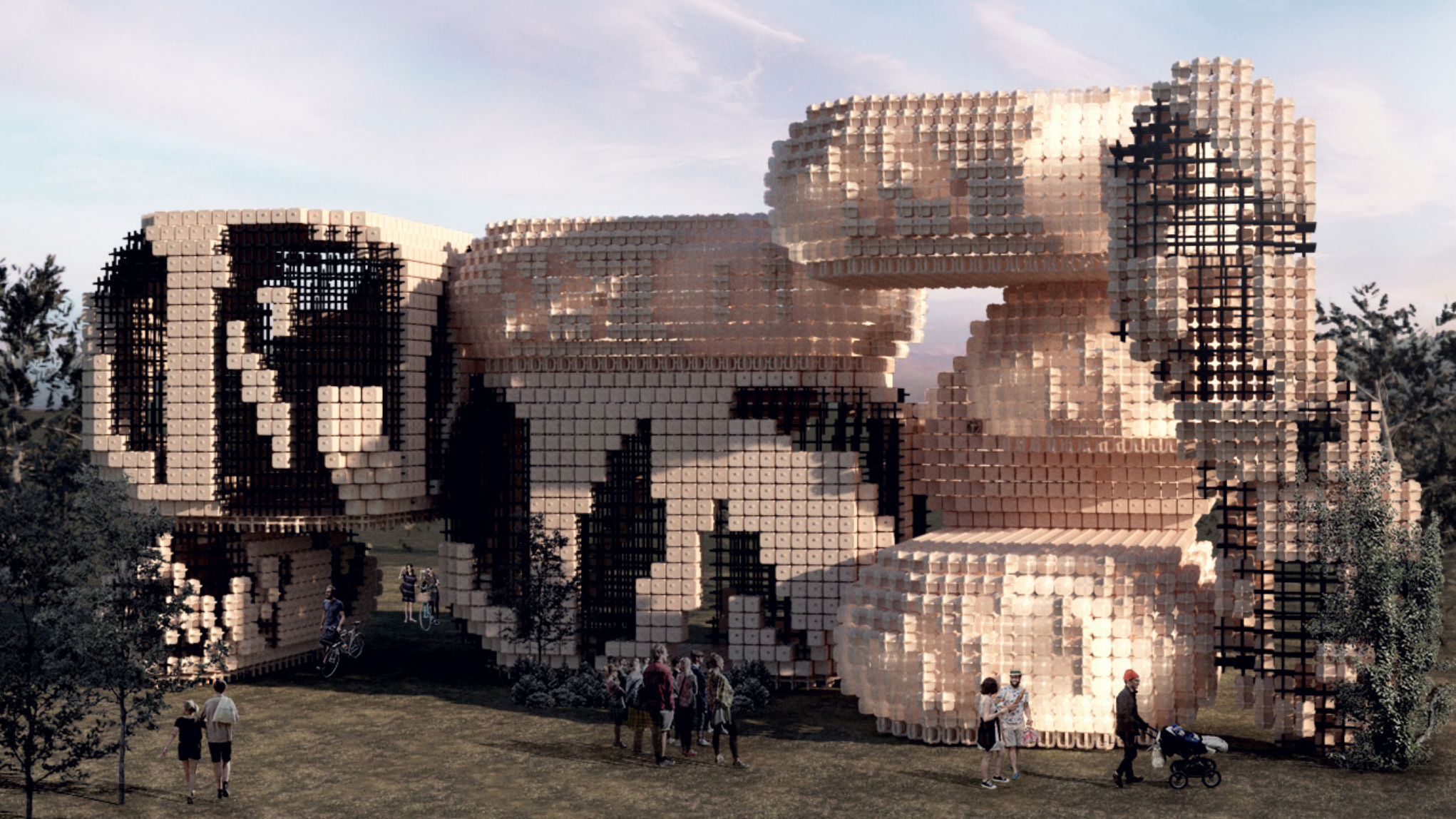
This research asks whether architecture can operate as a continuing system rather than a one-off artefact. Through modular construction and autonomous robotic reconfiguration, the system explores a cultural centre able to reorganise its spatial framework in response to changing programmes and user feedback.
II. Mechanical Design
From single locomotion
to collaborative
construction tasks.
01. Behavior design 1: Movement
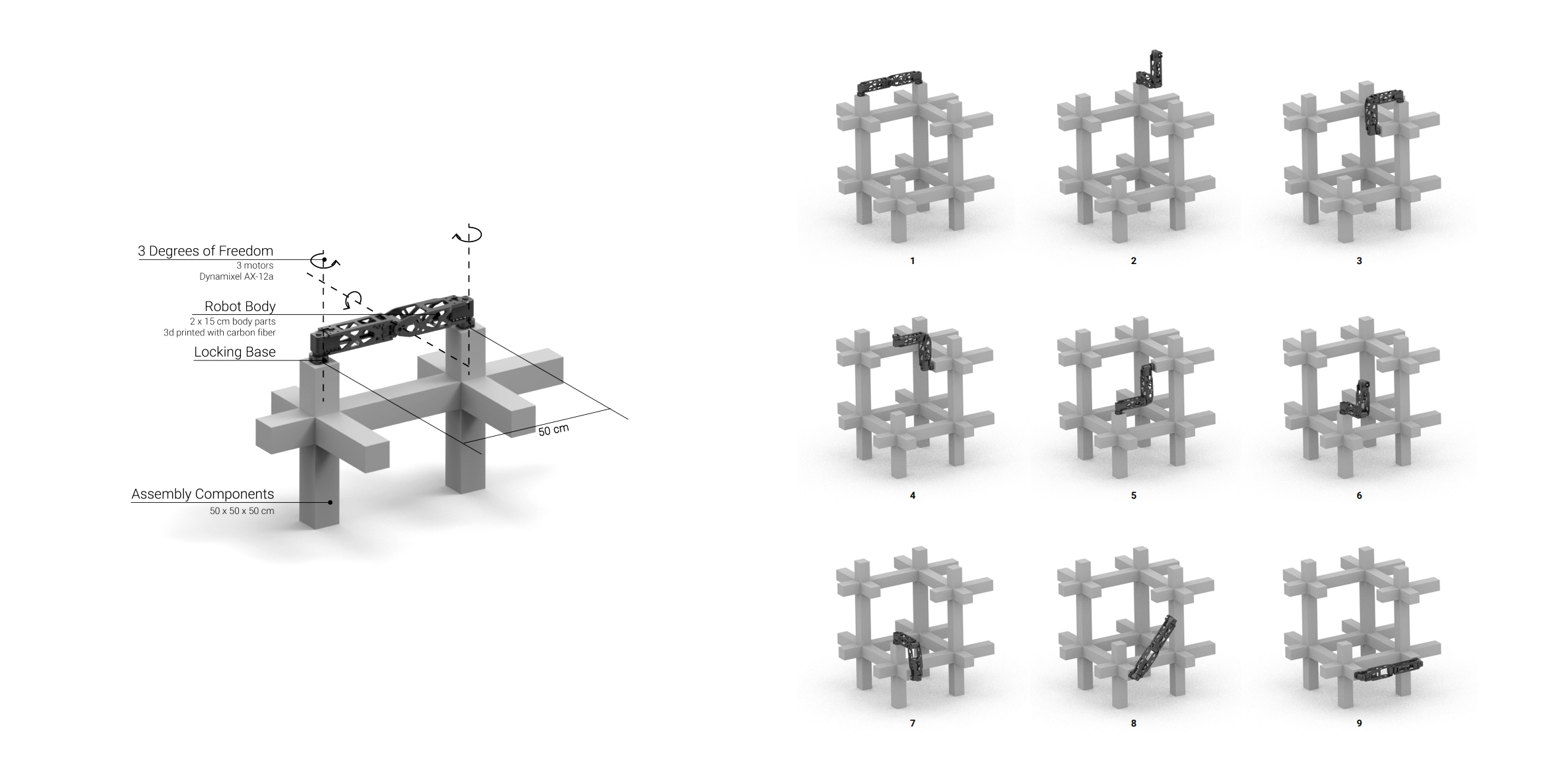
Movement research begins with a simple requirement: reorganise modular architectural parts with the fewest necessary actuations. The unit is derived from precedent work on small construction robots, but is redesigned around modularity and robot-to-robot collaboration rather than a single universal machine.
The system combines robots with different actuator counts and degrees of freedom. For simple locomotion, one robot can move independently across the structural grid; for more complex assembly tasks, multiple units can cooperate, assigning only the required actuators to each operation. This keeps the platform lighter, faster and easier to scale.
02. Behavior design 2: Grabbing
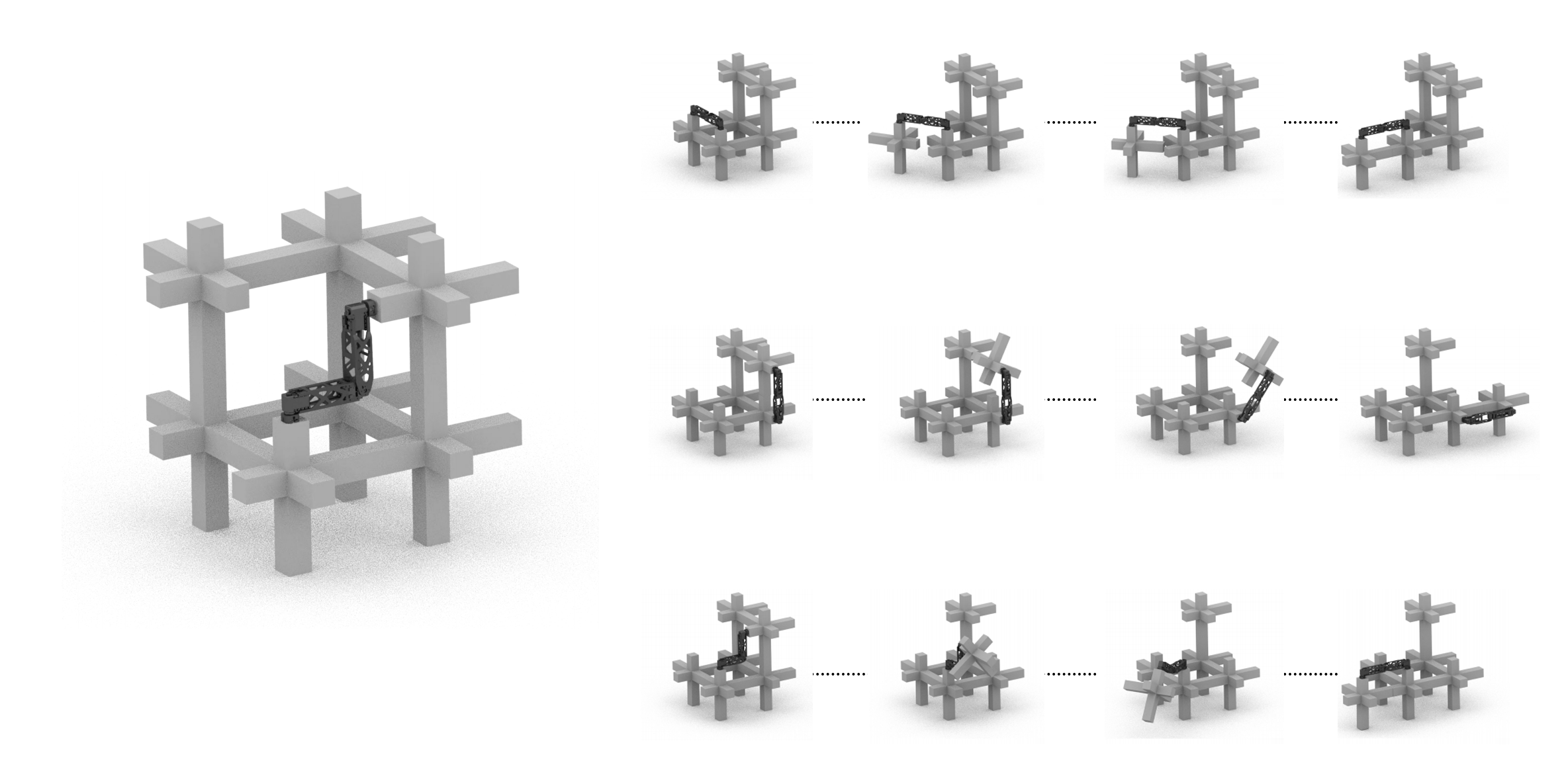
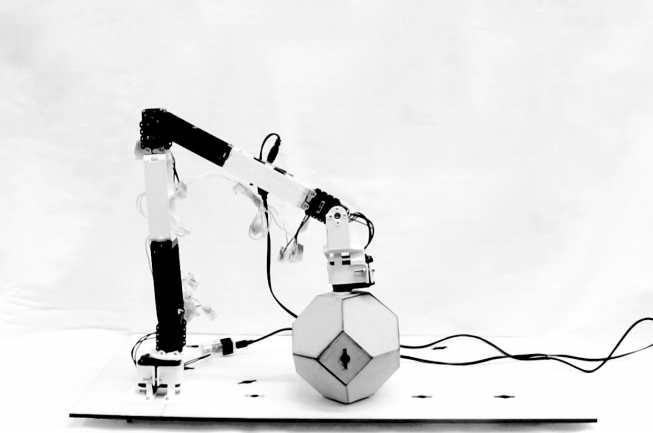
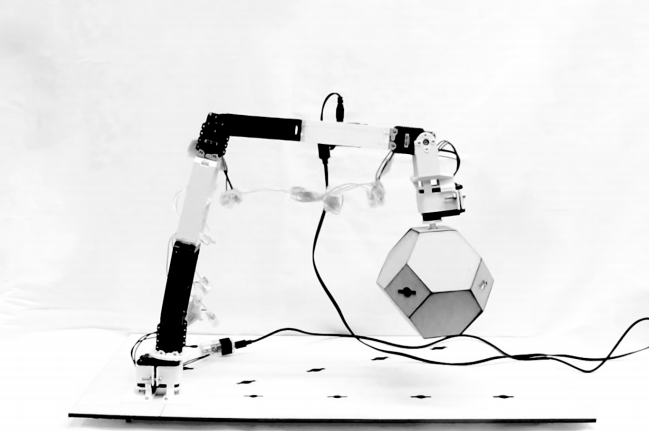
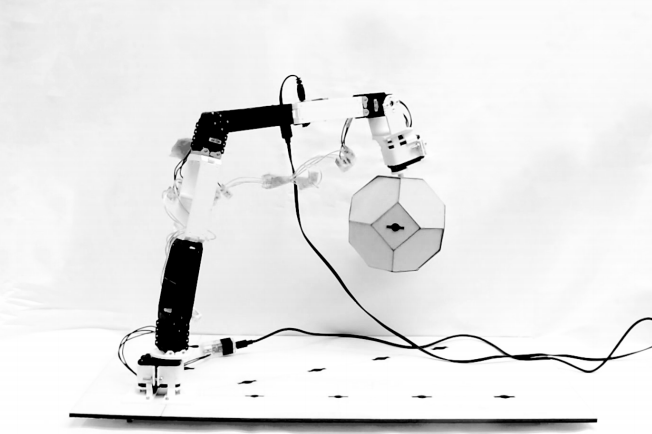
The grabbing behaviour extends the movement unit from locomotion to material rearrangement. With three degrees of freedom and a locking interface, the robot can climb across modular voxels, then grip, release and reposition them within the structural grid.
This allows the system to move components horizontally, vertically and diagonally rather than treating the grid as a fixed scaffold. In a multi-robot setup, grabbing becomes the operation that turns individual movement into collective construction and spatial reconfiguration.
03. Prototype design
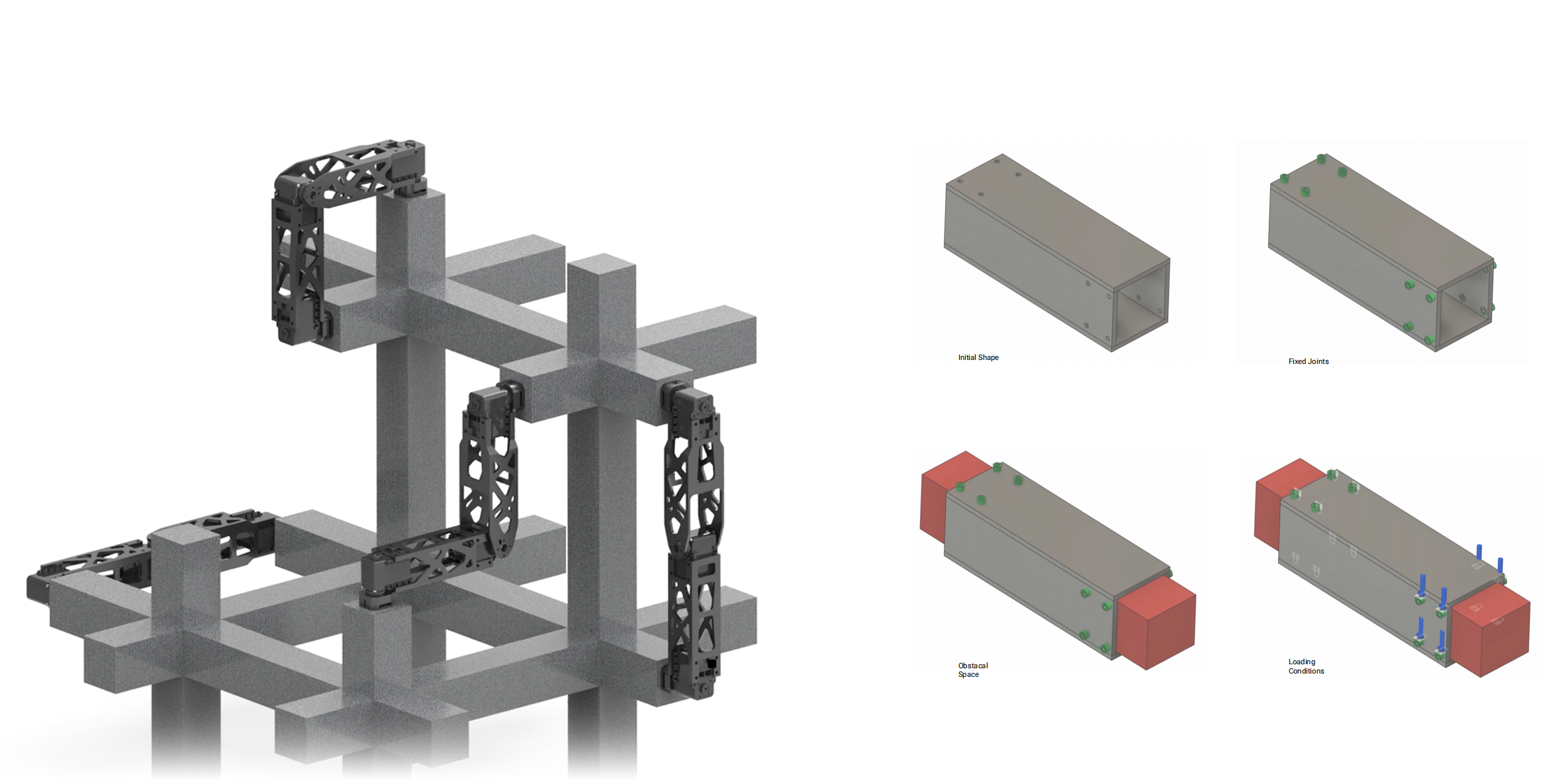
The robotic body is designed as a lightweight generative structure rather than a solid mechanical shell. Its aim is to carry higher loads while reducing mass and volume, leaving enough internal space for motors, joints and assembly interfaces.
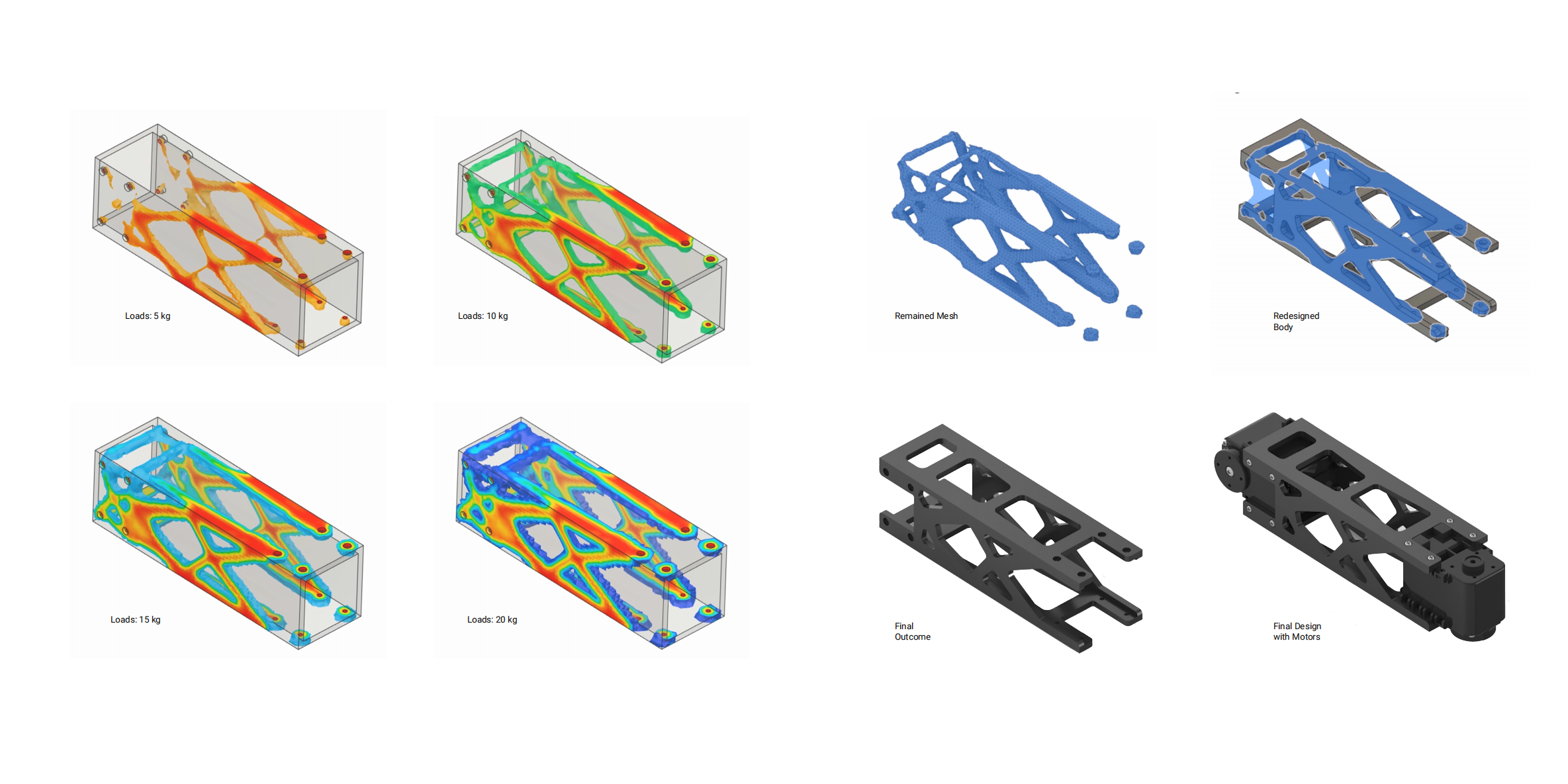
Fusion 360 was used to test the body under different loading conditions. A simple rectangular starting volume was constrained with fixed joints that represent bolt connections, while reserved obstacle spaces protected the motor zones. Loads based on the voxel scale and material assumptions were then applied to the joint positions.
The stress results were exported as mesh data and used as the main reference for redesigning the robot body. This process translated structural performance into a lighter frame with openings, reinforced paths and integrated motor connections.
04. Design iteration
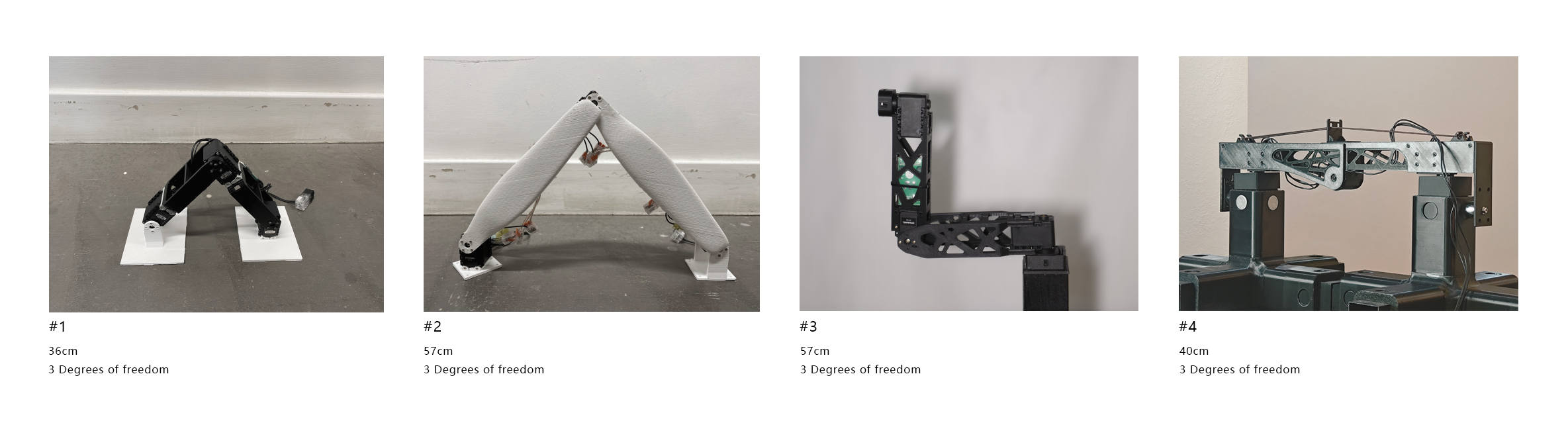
The robotic arm was developed through several rounds of physical iteration, responding to the functional requirements of movement and grabbing as well as hardware constraints such as servo power, structural weight and the behaviour of 3D-printed materials.
Each prototype adjusted the span, body length, joint arrangement and material strategy. The iteration process gradually reduced unnecessary mass, improved the relationship between actuator capacity and structural reach, and clarified how the robot should attach to modular building units.
05. Design details
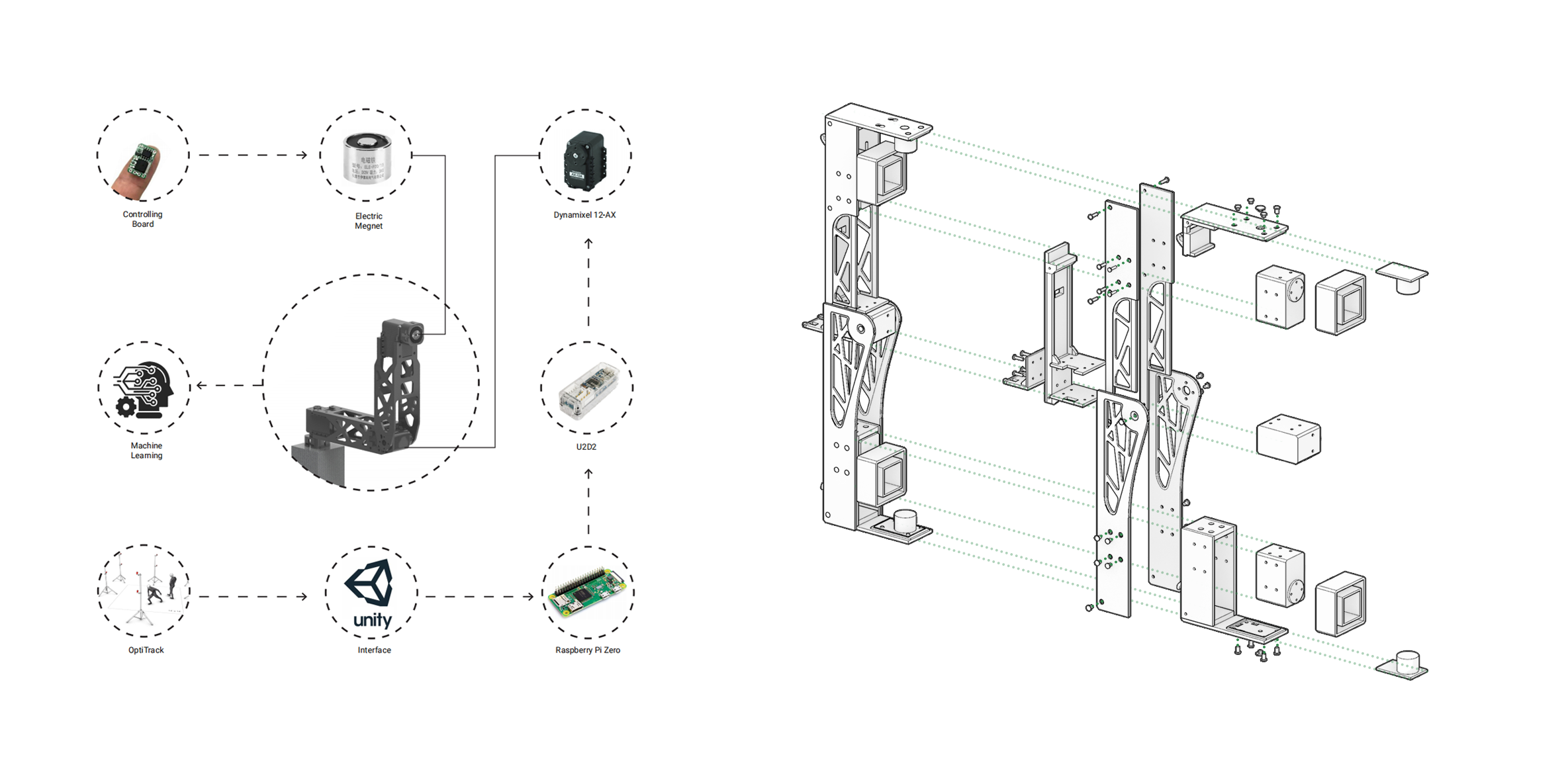
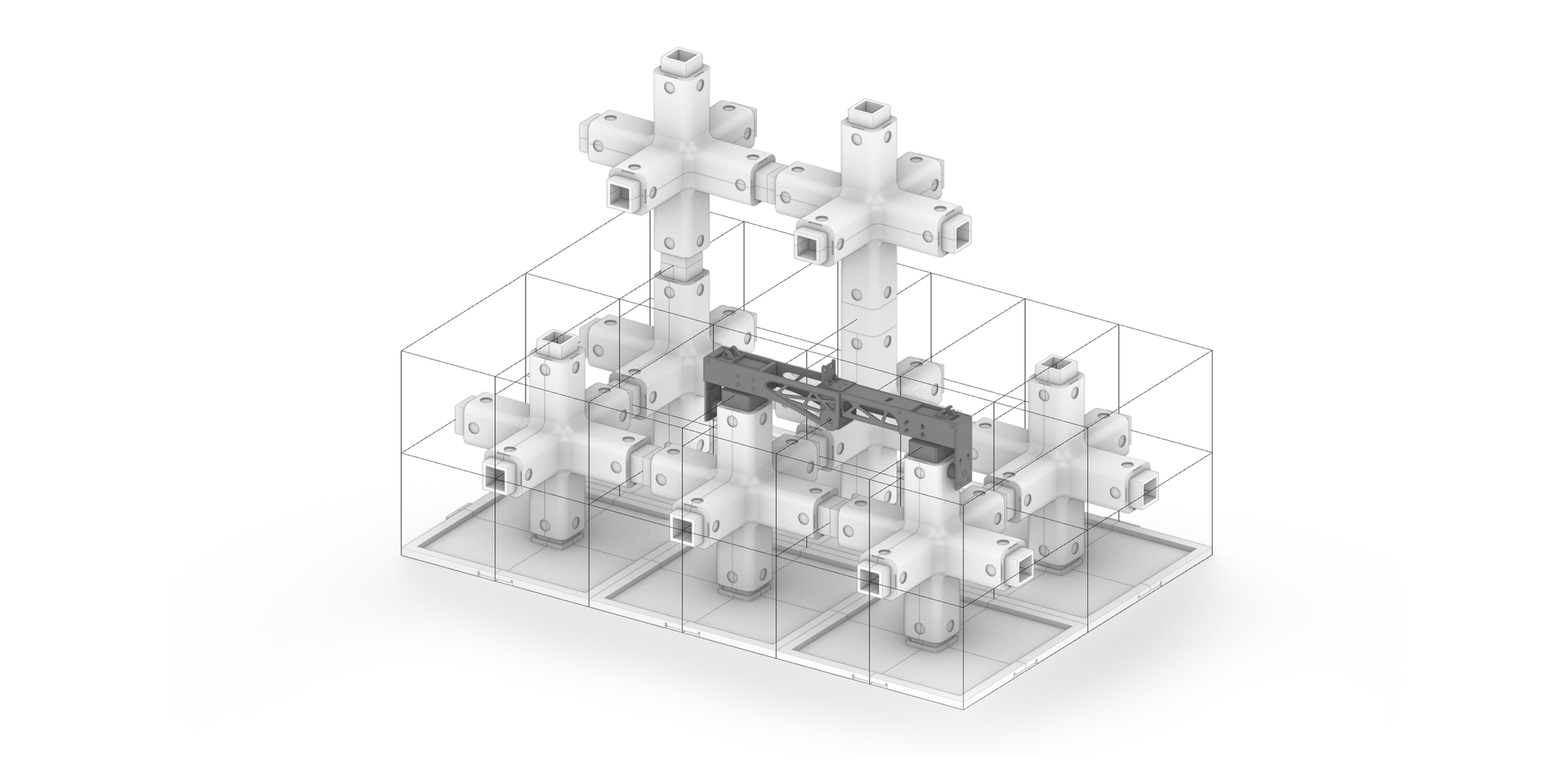
The robotic system is assembled from two generatively designed and 3D-printed body segments, two locking feet with electronic magnets, and three Dynamixel AX-12A motors. The mechanical layout keeps the actuator modules, locking interfaces and structural body readable as replaceable parts.
Unity is used as the control interface for collecting input data, simulating robotic movement and sending motion signals to the Raspberry Pi. Raspberry Pi and U2D2 act as signal converters, allowing the three motors to receive rotation commands. The electric magnets in the locking feet are controlled independently so the robot can attach to, release and reposition voxels.
OptiTrack provides external position tracking for the robot and surrounding voxels, feeding spatial information back into Unity. Machine learning is introduced as an additional feedback layer for analysing robotic behaviour and improving movement strategies over time.
06. Structural unit design
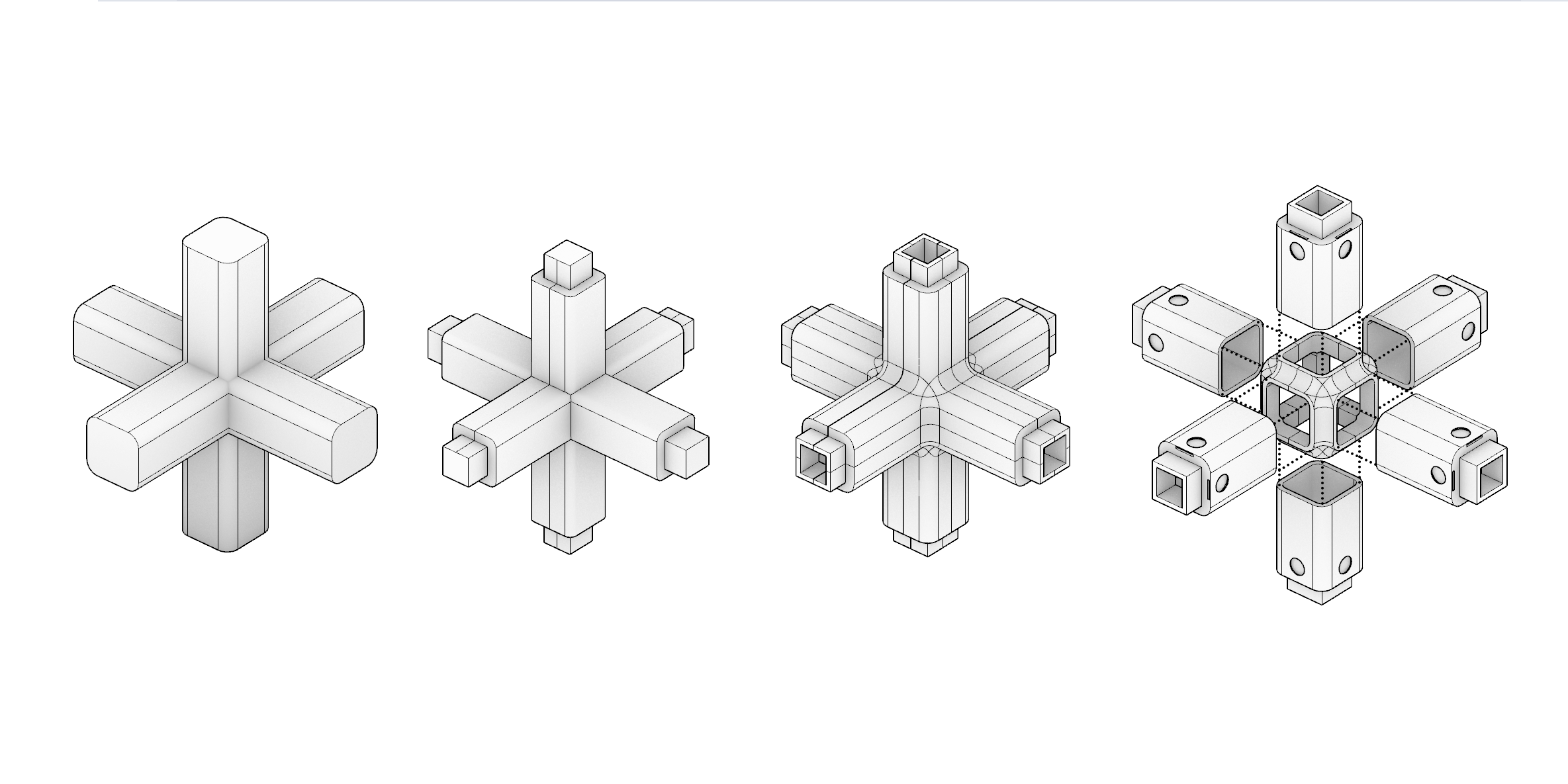
The structural unit was also refined through several iterations so it could work with the robot's movement path and load capacity. The early solid cross-shaped joint was developed into a lighter hollow connector with open ends, bolt holes and clearer interfaces for robotic locking.
The final unit keeps the six-directional connection logic of a voxel grid while introducing assembly details that support repeated attachment, release and replacement. When aggregated, the units form a structural field that can be climbed, reconfigured and extended by the robotic arm.
III. Physical Build
From direct control
to sensor-driven
embodied interaction.
01. Operation Mode I: Gesture Recognition
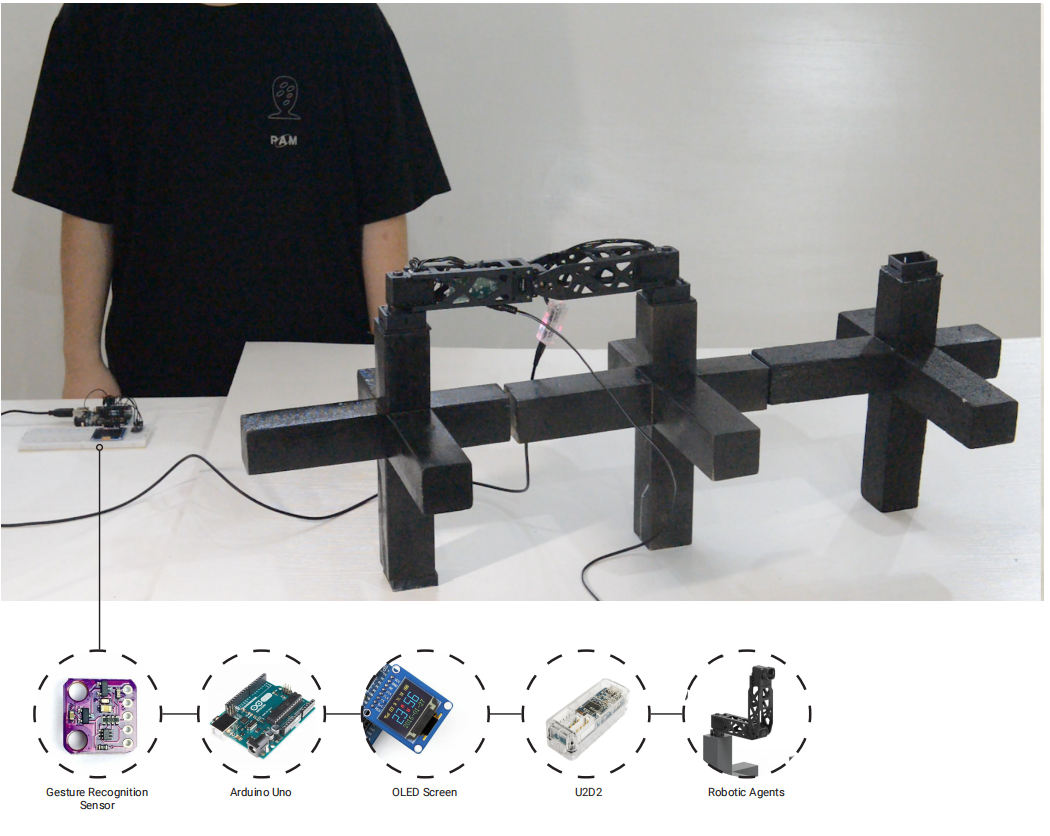
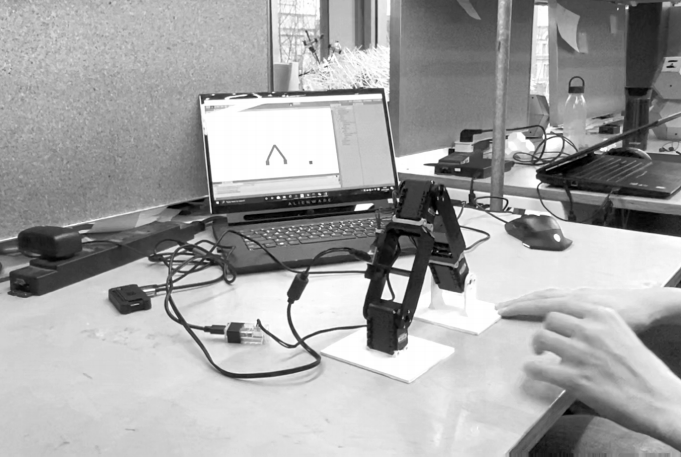
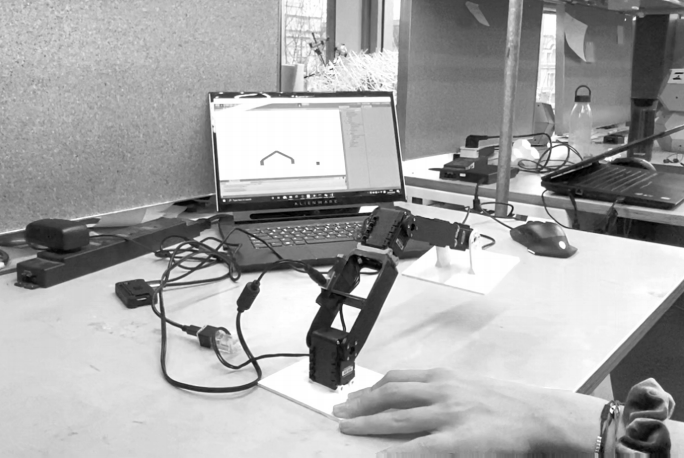
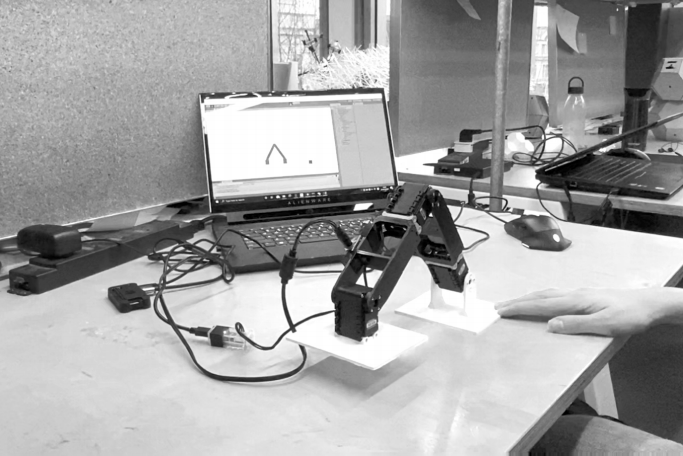
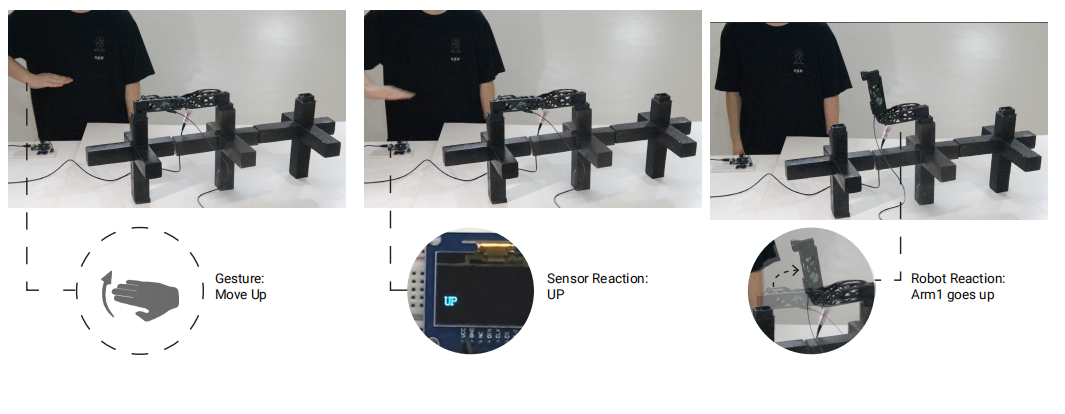
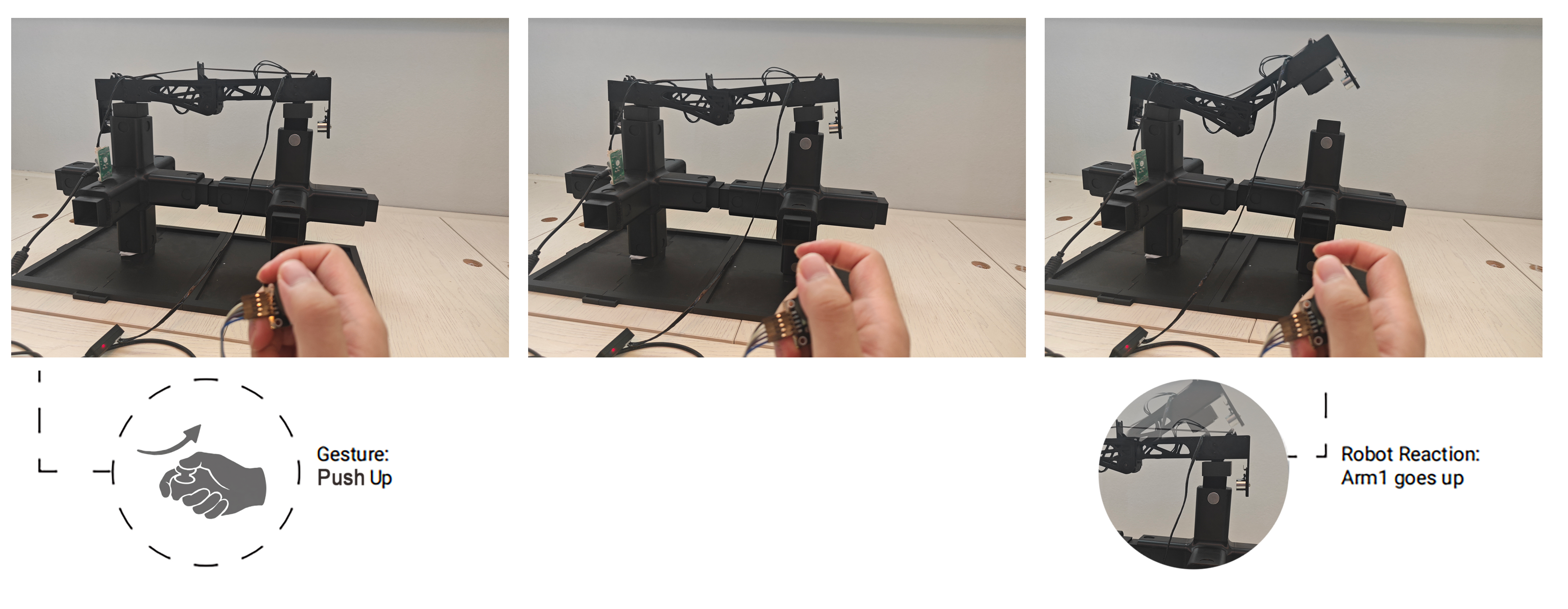
To evaluate how the construction robot could be operated beyond conventional controllers, the prototype was connected to a gesture-recognition sensor. Hand movements are interpreted by an Arduino Uno, displayed on an OLED screen, relayed through a U2D2 interface and translated into joint commands for the robotic agent.
The test demonstrates an intuitive, embodied control method: raising a hand triggers the corresponding arm to lift. Gesture input makes the robot easier to understand and more engaging to operate, but the prototype also revealed latency and occasional recognition errors. These limitations informed the later comparison of more reliable control modes.
02. Operation Mode II: Remote Control
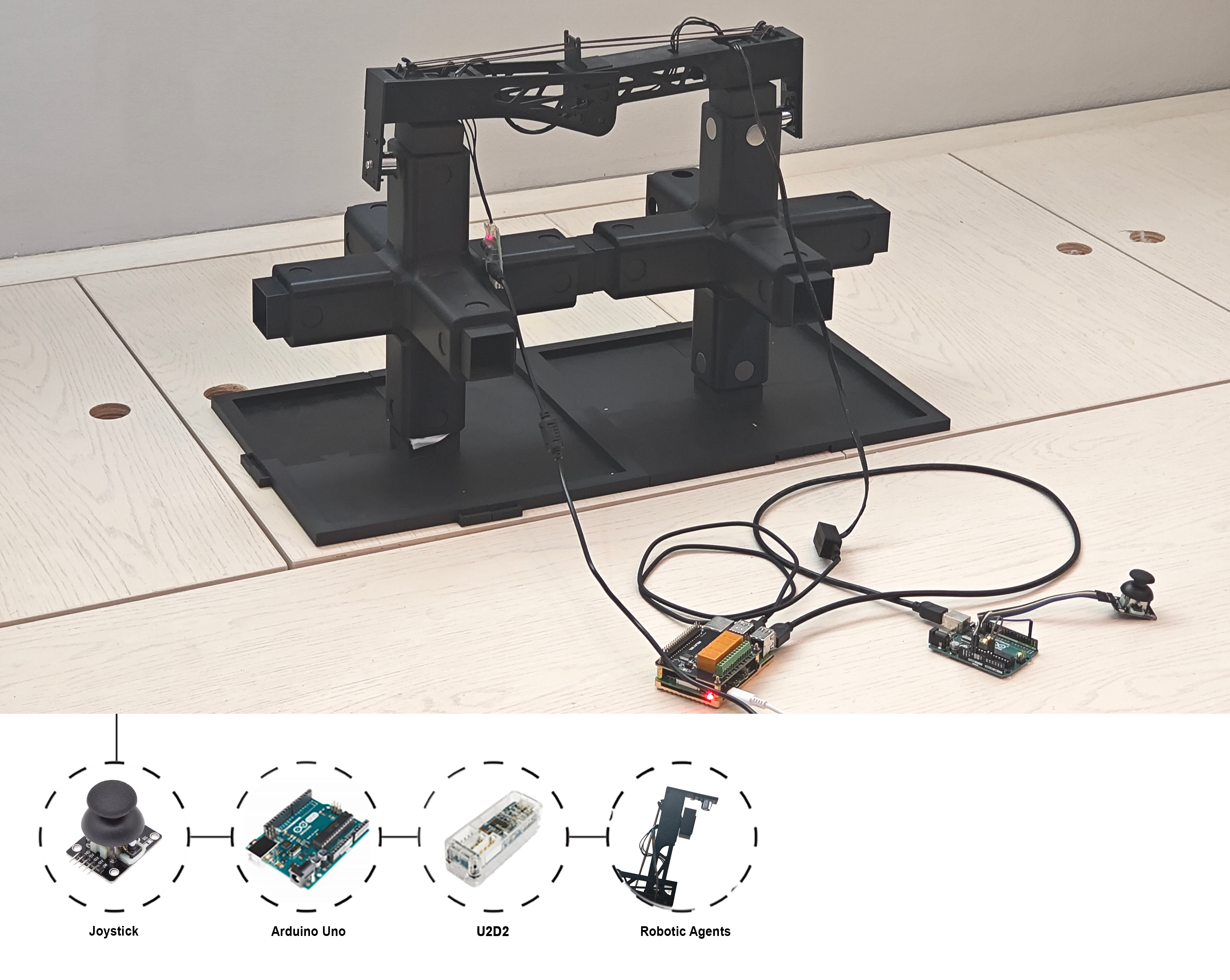
To reduce recognition uncertainty, the second prototype replaces gestural input with an analogue joystick connected through Arduino Uno. Axis values provide continuous directional commands, which Arduino translates and relays through the U2D2 interface to the robot's Dynamixel actuators.
The joystick provides more predictable, fine-grained control than gesture sensing and makes repeated motion tests easier to reproduce. However, the signal path introduces several intermediate devices and a redundant connection hierarchy. The accompanying hardware also exposed insufficient electromagnet output, limiting the robot's ability to hold structural units securely.
03. Operation Mode III: Game Controller
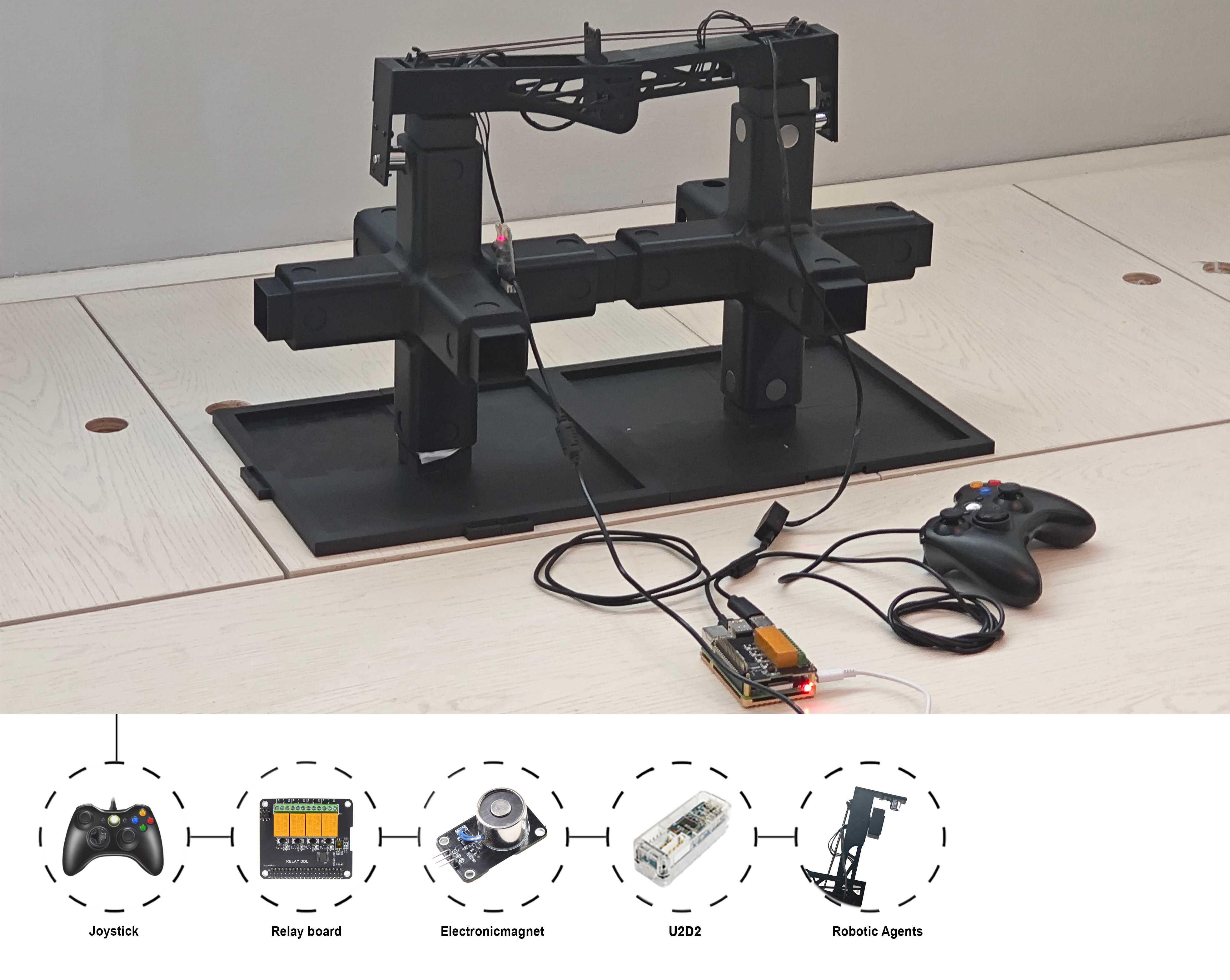
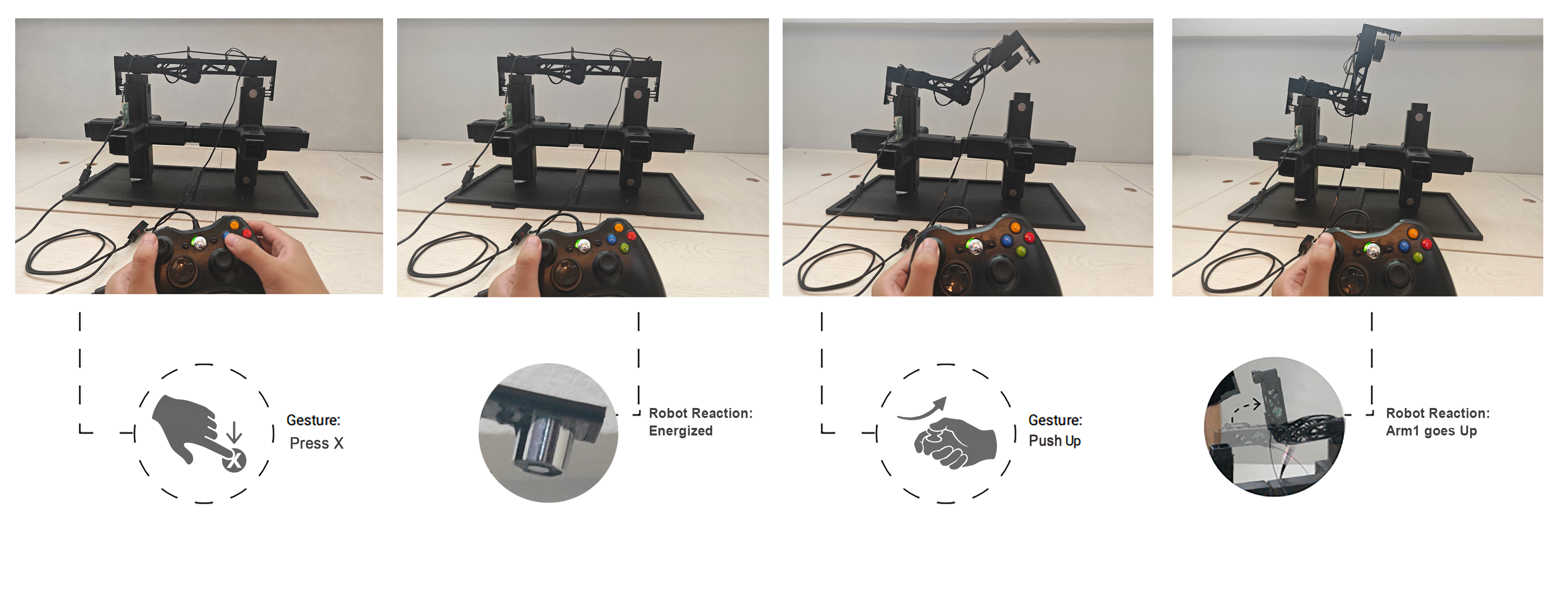
The final control configuration connects a game controller directly to the Raspberry Pi, removing the Arduino layer and simplifying the input pipeline. Multiple buttons and analogue sticks can be mapped to pre-programmed motion sequences, joint control and electromagnet switching within a single handheld interface.
This configuration combines reliable command input with a more familiar and engaging interaction. Its expanded button set supports a larger library of programmed behaviours while the shorter hardware chain improves setup efficiency and reduces connection failure points. The controller was therefore selected as the primary interface for subsequent physical demonstrations.
04. Live-action Video
After several coordinated hardware and software iterations, the final prototype achieved stable physical operation. The live demonstration documents the robot's response and movement within the assembled test environment, confirming that its mechanical body, actuation, power supply and control logic can operate as an integrated system.
IV. Spatial Composition Research
From modular units
to adaptive
spatial fields.
01. Modular research
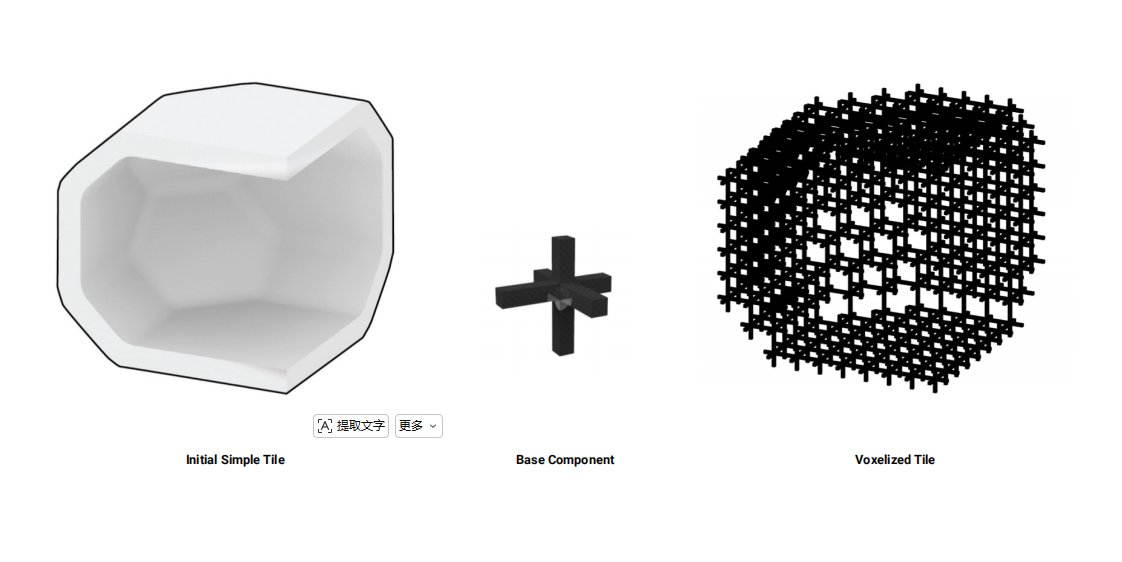
Each structural unit works like a spatial pixel. By connecting these units into a voxel grid, the system can translate small-scale component logic into larger architectural envelopes, walls, openings and interior voids.
Digital simulation is used to test how repeated units generate different spatial effects. Instead of designing a single fixed form, the project treats form as an editable field that can be reorganised through rules, feedback and robotic assembly.
02. Structural unit variations
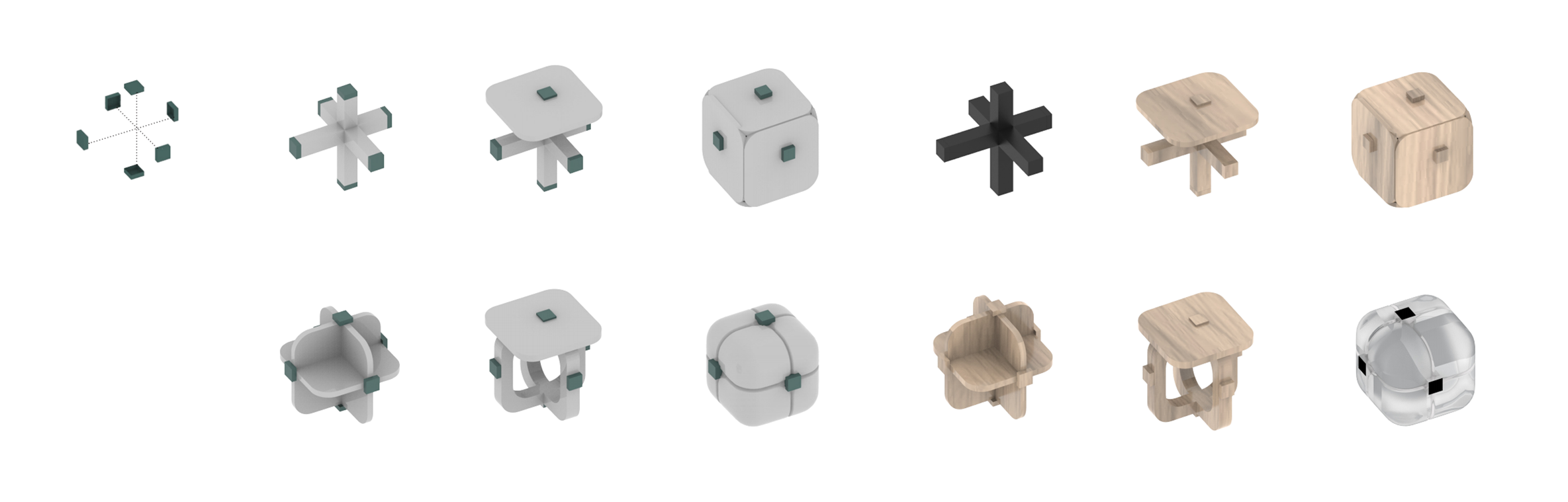
The structural unit can be developed into multiple variants by changing material, enclosure and connection details. Solid, hollow, timber and transparent versions respond to different degrees of privacy, light transmission, structural expression and environmental demand.
These variations keep the same connection logic, allowing different unit types to coexist within one assembly system. The building can therefore shift between open framework, enclosed room, translucent boundary and inhabitable furniture without abandoning its modular construction rule.
03. Spatial form design
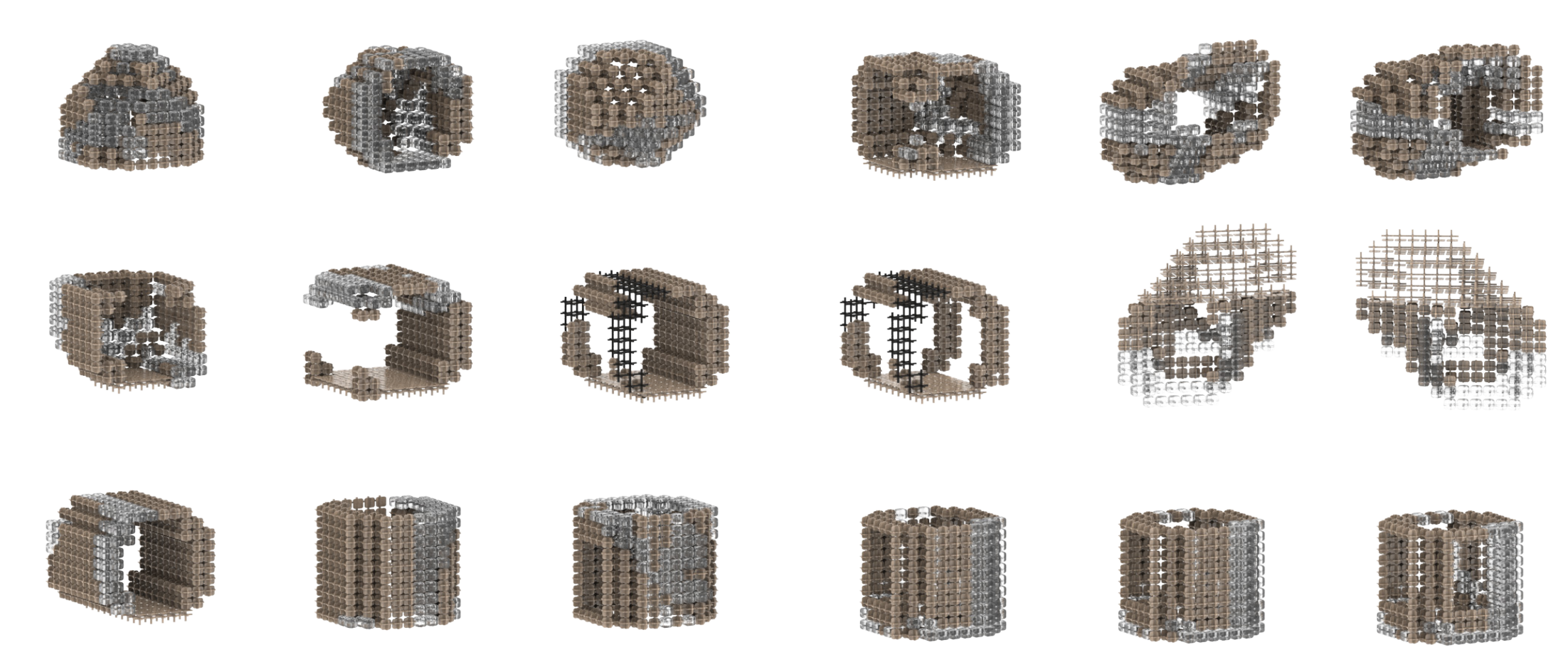
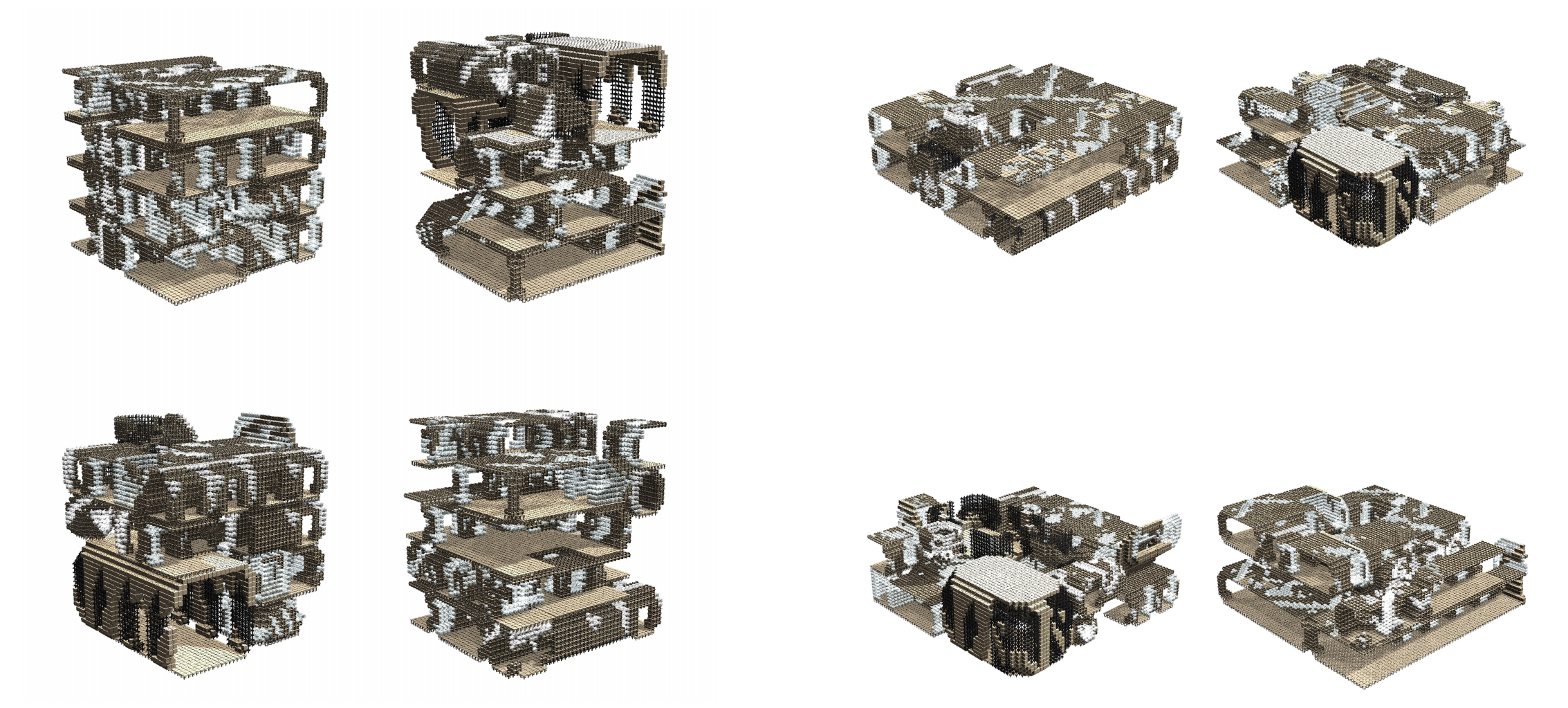
Future spatial generation can combine multiple algorithmic layers, such as spatial syntax, cellular automata and Conway's Game of Life. Designers can input site conditions, programme requirements and user feedback as constraints, allowing the system to search for architectural configurations rather than manually fixing one final model.
The resulting forms show the cultural centre as a continuously editable structure. Floors, walls and openings can be redistributed according to changing activities, while the robotic system provides a physical pathway for turning computational proposals into built reconfiguration.