01. Research references

Frei Otto was a German architect and engineer, and a pioneer of lightweight tensile and membrane structures. In works including the German Pavilion at Expo 67 and the roofscape for Munich Olympic Park, he treated architecture as a process of finding form from material behaviour rather than applying a predetermined geometry. In his soap-film experiments, material became an active form-finding tool: under boundary constraints, the film naturally formed minimal surfaces, revealing the relationship between tension and form.
Yona Friedman and his People's Architecture add an urban and social dimension: an open framework can be adjusted over time by its inhabitants rather than completed as one final arrangement. Similarly, the University of Stuttgart ICD / ITKE projects Textile Hybrid M1 and BUGA Fibre Pavilion demonstrate how bending rods, textile membranes and fibre structures can be integrated into buildable lightweight spatial systems.
LOOPS therefore does not simply pursue a flowing form; it brings Otto's material form-finding, the force-generated space of textile hybrid structures and Friedman's open, variable framework together through modular rules and actuation that keep space responsive to people and its environment.
02. Research purpose

ELAbot stands for a Bending Active Textile Hybrid (BATH) structure. By utilizing continuous elastic material actuation, the physical structure can self-deploy and adapt into multiple 3-dimensional states in response to human, material, and machine interactions. The multidisciplinary framework bridges architecture, computer science, and soft robotics.
LOOPS extends the exploration of the tutor-led ELABOT project, using robotic systems and bending-active textile hybrids to investigate further possibilities across material, movement, and space.
02 / MATERIAL RESEARCH
From bending rods
to textile hybrids.
01 / BENDING RODS
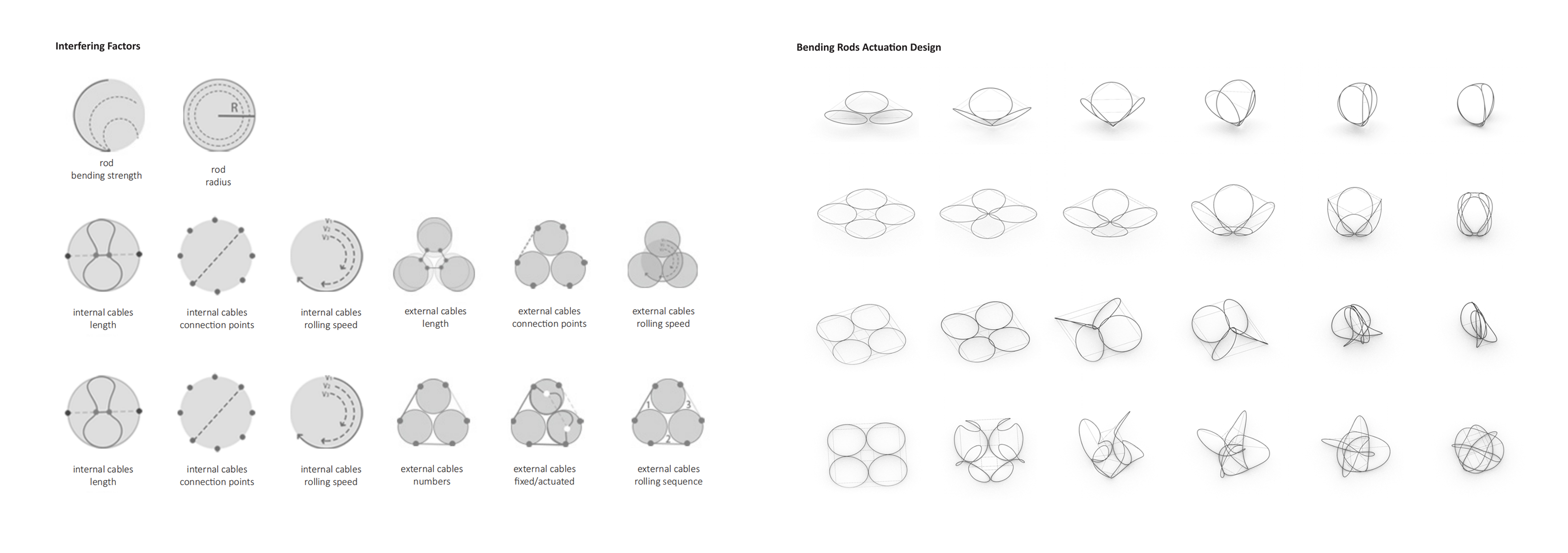
Research began with an ordinary elastic rod. When connected end-to-end into a loop, the base unit produced rich deformations through changes in size, strength and external forces.
Three and four identical loops were then connected into larger systems. Shifting their geometric connection points produced dynamic structural experiences distinct from rigid materials.
02 / TEXTILE HYBRIDS
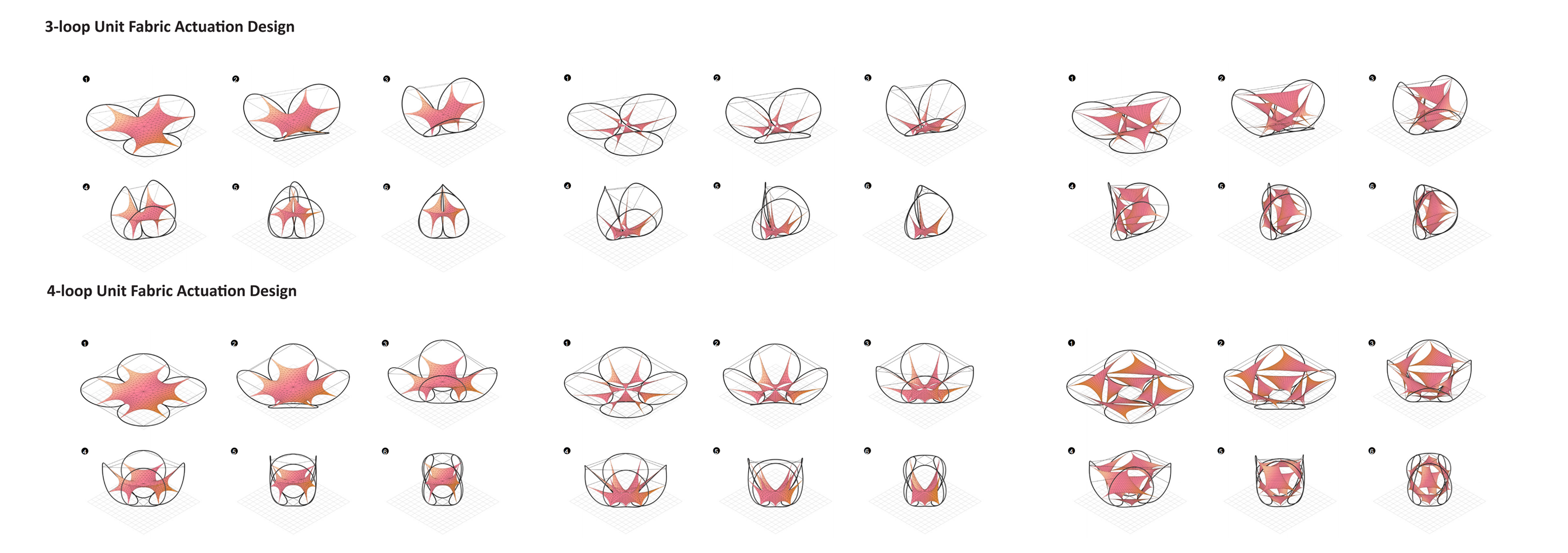
Different methods of applying elastic textile further enhance the structure's enveloping quality and shape the relationship between interior and exterior space.
The textile does not simply cover the frame. It redistributes force across the loops, makes transformation legible to the body and gives the system a softer architectural presence.
03 / ROBOTIC MOVEMENT
Giving the system
agency.
01 / TECHNICAL ROADMAP
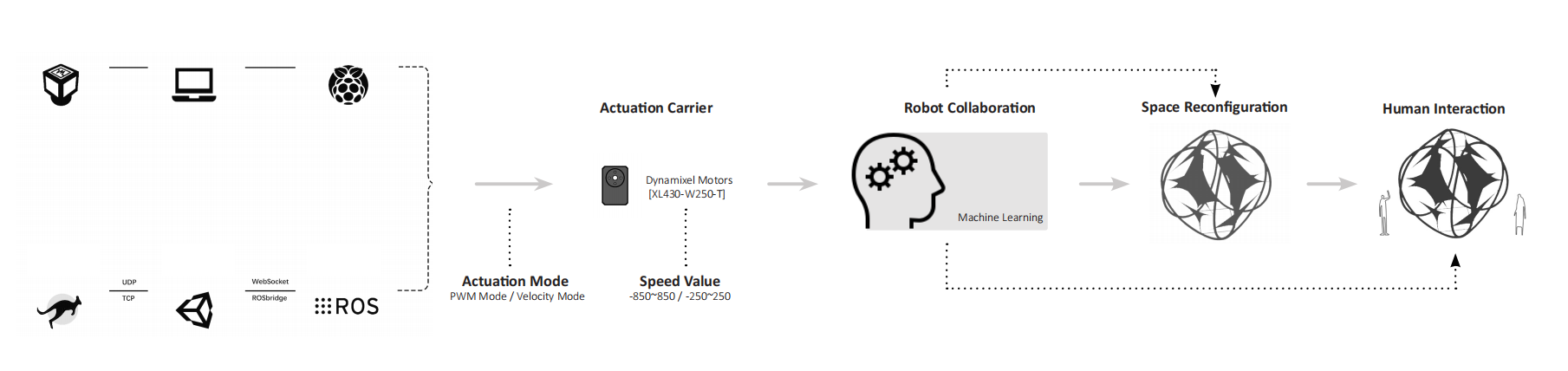
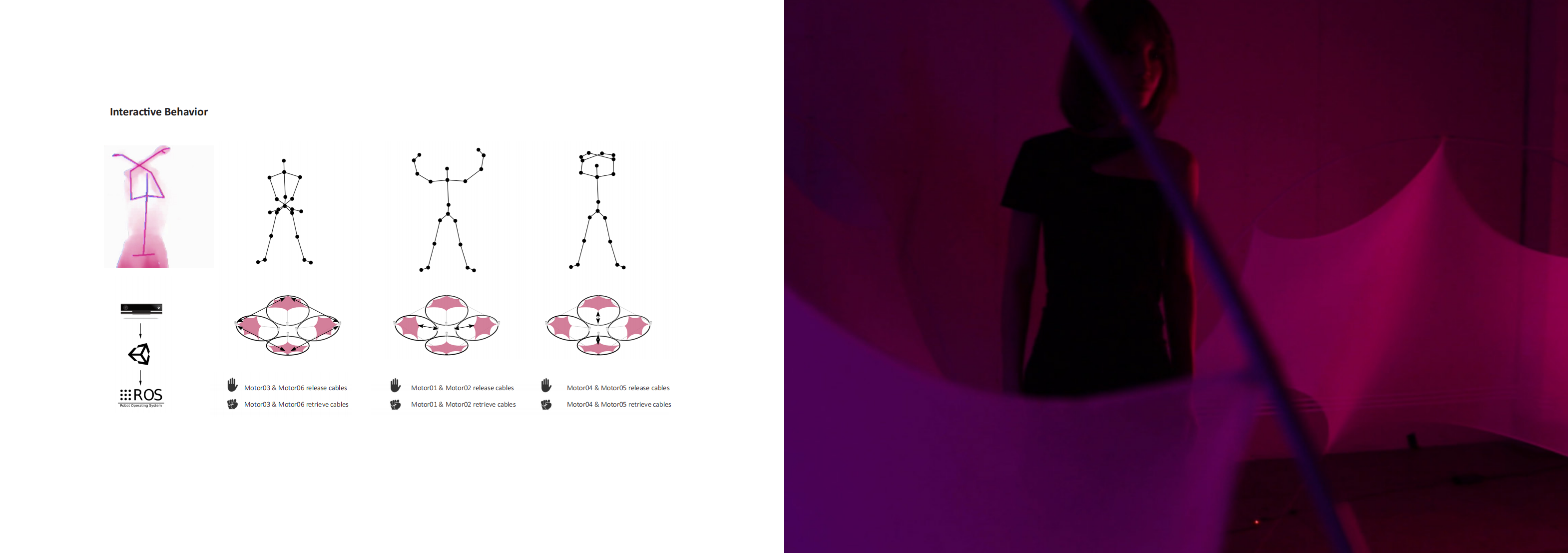
The control route links software environments to Dynamixel actuators through ROS, allowing movement parameters to circulate between simulation, sensing and physical actuation.
Rather than treating control as a separate technical layer, the route is designed as part of the material system: each command produces a visible spatial consequence and each physical response informs the next adjustment.
02 / PHYSICAL SETUP
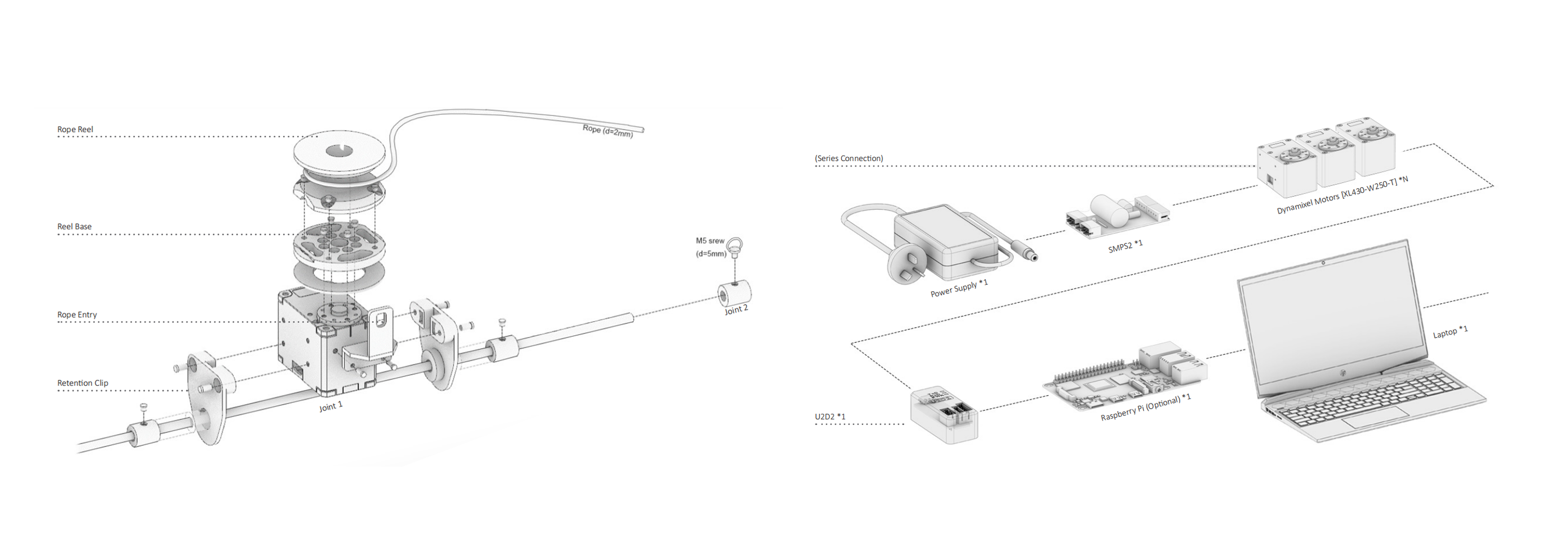
Each actuator carrier is calibrated through speed and motion modes so that multiple modules can collaborate. The setup supports movement as both an operational system and a spatial design tool.
The assembly remains deliberately modular, allowing components to be exchanged, repositioned and tested at different scales while preserving the relationships between rod, textile and actuator.
02 / CRAWLING
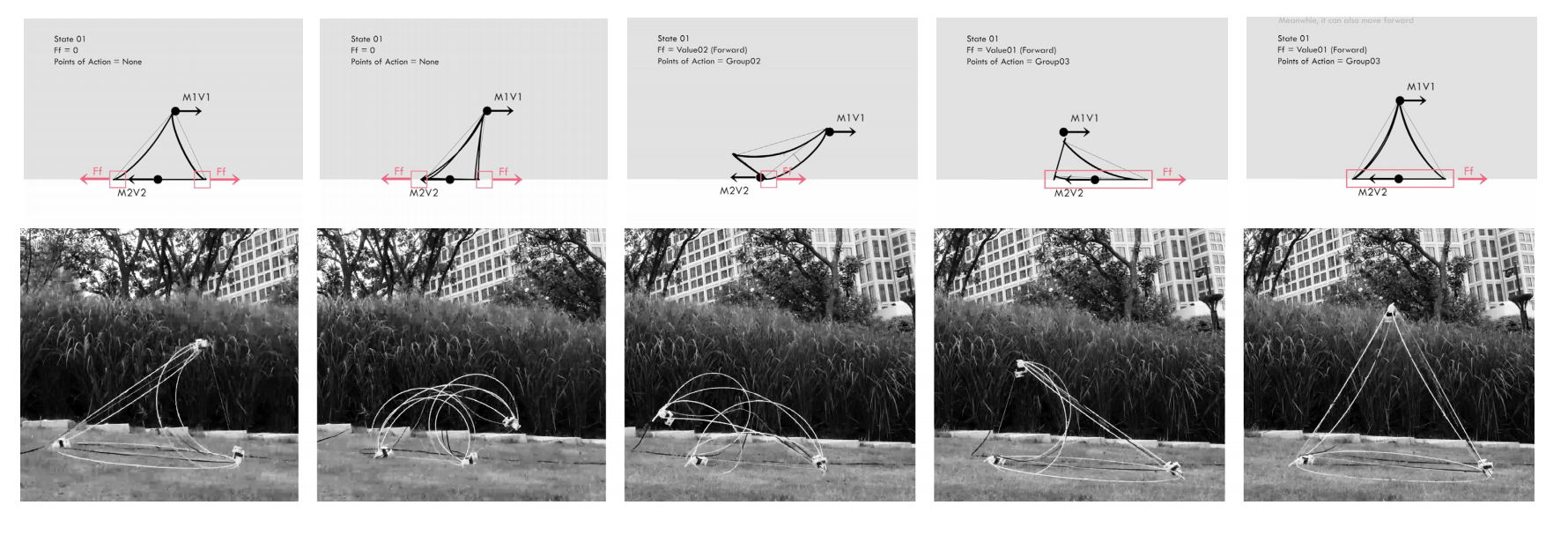
Simulation establishes timing relationships between modules before the sequence is transferred to the prototype. The physical test reveals how friction, weight and textile tension reshape the intended motion.
This feedback loop makes crawling more than a predefined animation. It becomes a negotiation between computation and the specific material conditions encountered by the body.
a. Simulation
b. Physical prototype
03 / SELF-FORMING
The sequence compares digital simulation with the physical prototype to study how distributed force produces stable yet changeable form. The result is a system that can both occupy and transform space.
By changing the order and intensity of local actuation, the same network can shift between flattened, enclosed and elevated states without replacing its underlying material logic.
a. Simulation
b. Physical prototype
04 / SPATIAL RESEARCH
Scaling the hybrid system
into space.
01. Mechanism design
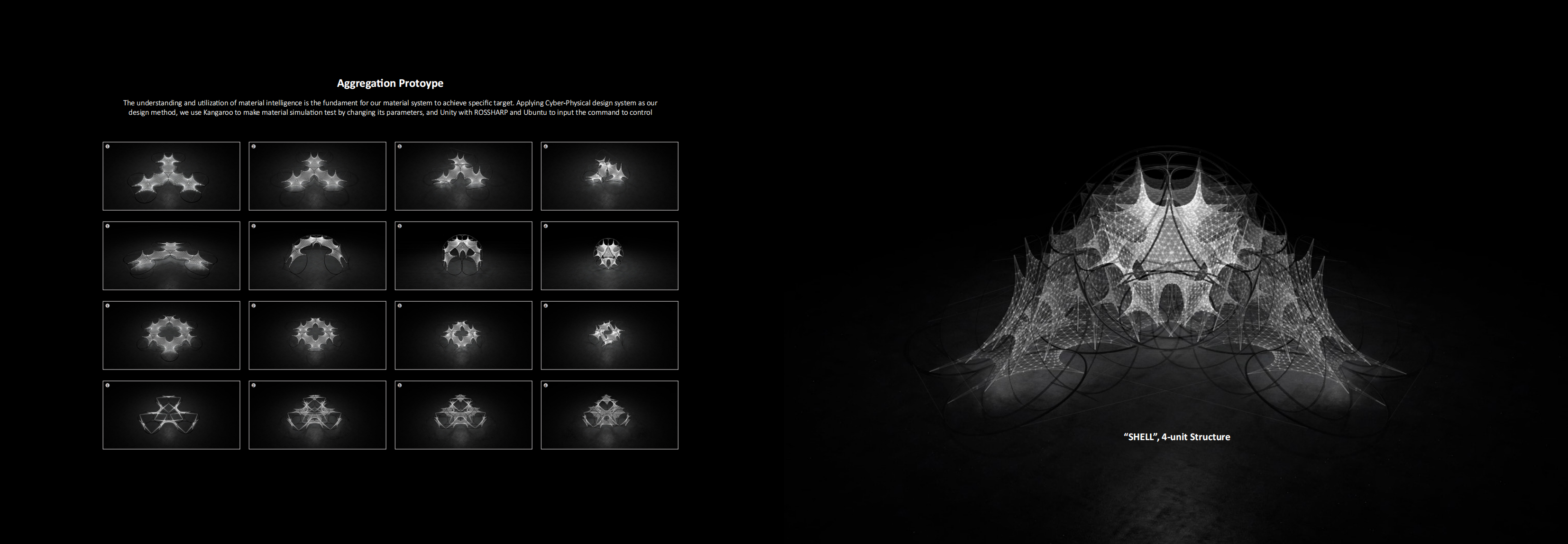
Aggregation uses repeated hybrid units to move from a single prototype to a spatial system. Variations in the number, connection and actuation of units produce different degrees of openness and structural expression.
The studies position reconfiguration as an architectural quality. A larger field can reorganize through local changes rather than through a fixed master plan or a single final form.
02. Form research
05 / OUTLOOK
Interaction and
collective vision.
01. Iteration route
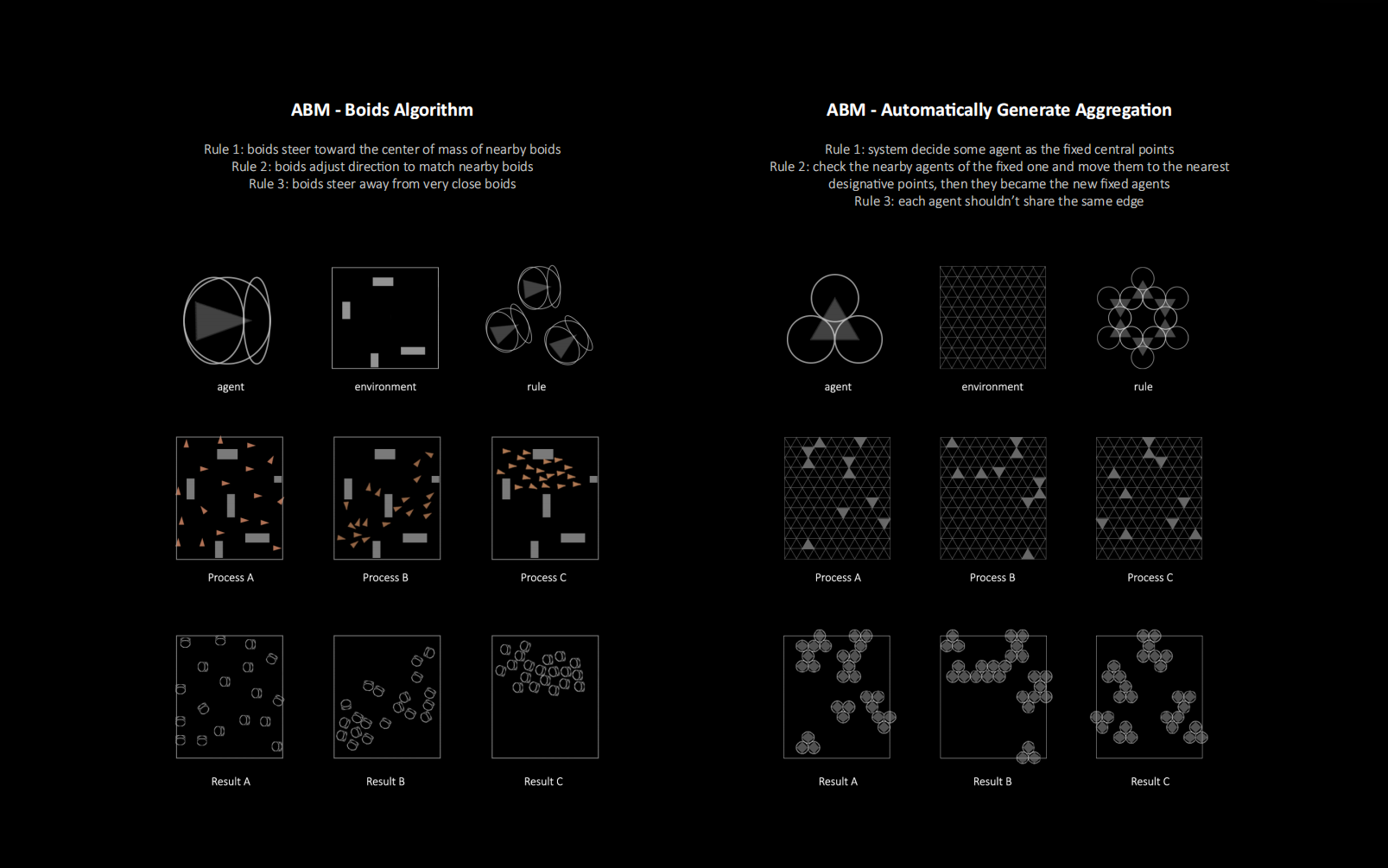
Agent-based rules are used to explore how local decisions can create larger collective patterns. This offers a path for the system to evolve from robotic prototypes into participatory spatial applications.
Future work considers how people, sensing and adaptive material systems might share agency, allowing the environment to register occupation and evolve through collective use.
02. Application scenarios